


This year certainly wasn’t lacking in shows; from both the old, well-established art spaces around town, to the newcomers that helped map out contemporary art production in China via thought-provoking shows. However, there are three spaces that stood out in particular in 2017, in part thanks to their consistency in the face of ever-changing circumstances and fickle political winds, and their ability to find new ways to convey evocative messages and engage audiences. Some did so by catering to viewers’ most hedonistic side – appealing to their acute sense of criticism – or by creating room for conversation about not-so-commonly addressed issues within the Chinese mainland art scene.
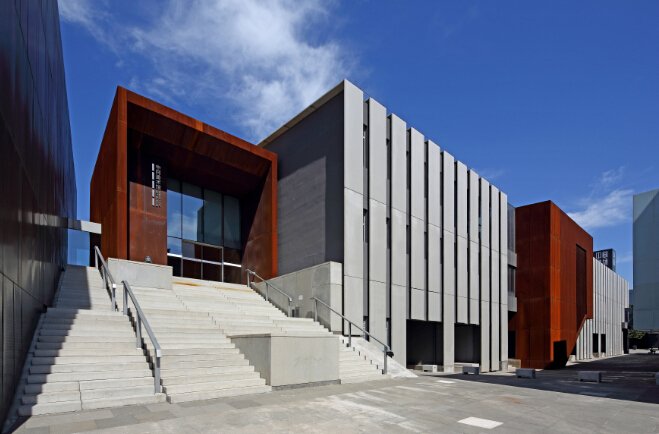
Our first hat tip goes to Inside-Out Museum (IOM), a nonprofit museum that opened in 2007 and, after two moves, is now located in the northeast of the city. Home to the likes of this year’s Self Criticism exhibition, Inside Out grabbed our attention for its role as an incubator for innovative curatorial approaches. In Self Criticism, a series of smaller exhibitions were comprised within a larger macro exhibition concept; curators were invited to generate ways in which to involve people in a self-criticism process and allow them, according to the curator, to “transcend the constant flux of information and events that bury their sense of awareness and the much needed action to produce change.”
In order to achieve the desired effect, the exhibitions were laid out without clear limits, connecting them in unexpected ways. One of the standout pieces was “Adequate Instructions,” a video installation of Alvin Tran’s work, curated by Yuan Fuca and Han Xinyi. In the story, the protagonists stage a representation of the awakening of consciousness in robotic creatures that go on to fight humans within a Westworld-inspired subtext.
Perhaps the piece that garnered the most attention was the sound-art project curated by Edward Sanderson, “Grounds for Sound,” in part thanks to Rong Guang Rong’s intense but quite remarkable metaphor through video and sound installation of the violent tension between confronted needs and realities. Through these pieces, IOM’s remote, lone-standing space solidified its worthy standing through a strong group of curatorial respondents.
M Woods, founded in 2014, has this year made noteworthy strides into the local art arena thanks to its approach of combining exhibitions with a particularly diverse program of related activities. This netted consideration from art aficionados as well as a younger crowd looking for new experiences in art-related spaces. One such experiment was the well-received (albeit hard-on-the-wallet) FAT Music Festival (pictured in the lead photo above), held in unison with some of Beijing’s finest live music venues – DDC, Temple, School Bar, and Fruityspace – cleverly drawing out crowds from their Dongcheng havens and introducing them to the gallery. In addition, 2017 has seen talks, educational programs, vintage bazaars, experimental food fairs, and noise shows occupy the space – you name it, they’re doing it.
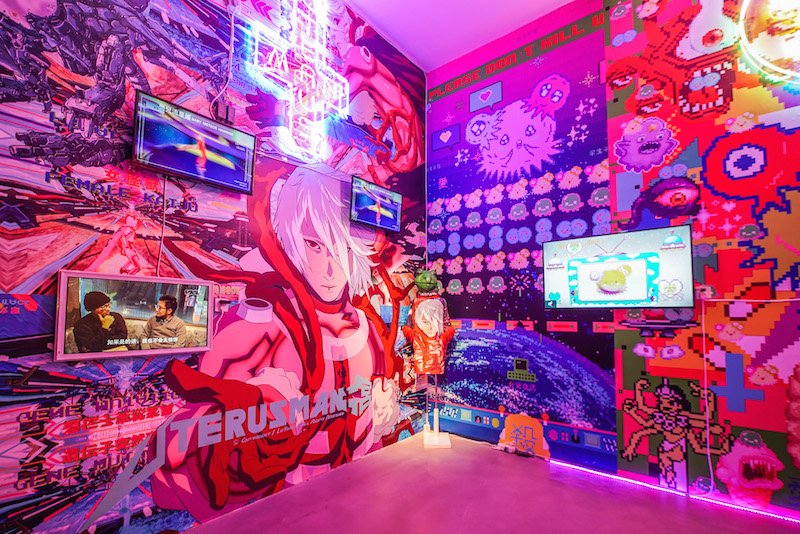
Whether these complementary activities grip you or not, M Woods is also building its name by hosting young artists that encapsulate the China zeitgeist. For example, Shanghai-born new media artist Lu Yang’s Encephalon Heaven (through Feb 11) solo exhibition – the first for a Chinese artist at the space – made up of three new commissions alongside many of the artist’s previous works in sculpture, film, installation, performance, and even video games. Yang’s visions are worlds in themselves and are heavily populated by a constellation of “pan-cultural” creatures influenced mainly by Buddhist and Hindu iconographies, neuroscience-imbued concepts, and anime-styled references. All this is presented with a touch of dark comedy and the visual impact of popular culture.
Particularly remarkable among the new works at the gallery space is “Electromagnetic Brainology,” an installation that incorporates motion sensor technology and is displayed in a sort of temple-like arranged space that blends together the world of the sacred and the profane (a regular theme in the artist’s work). In the video installation, Lu Yang personifies four deities and superheroes, and different areas of the human central nervous system, bringing a sort of intersection between superstition and cutting-edge science. The characters dance in choreography inspired by the games found in any respected arcade game center while combating the troubles of mankind.
Following the news of the UCCA’s recent ownership deal, we look forward to seeing how one of the most reliable art providers in the city expands on its vision of contemporary and diversified programming given the new resources and renovations promised by its new administration. Since its opening in 2007, the center has brought a stream of shows (approximately 100 exhibitions since its founding, according to its website), The New Normal (or as its Chinese title dubbed it, State of Exception) early in the year remained one of 2017’s Beijing art highlights. That show brought a constellation of emerging artists to the scene with works that explored the status of art today against a set of unprecedented social realities experienced worldwide. The UCCA in that regard, still has the ability to showcase critical works that no other space would be able to flaunt so easily.
On a final note, the UCCA’s open program offers opportunities to engage in themes and topics that are not part of the ongoing discussion at big institutions. Recently, for example, we were able to catch a glimpse of Inivisible, a series of talks, panels, and screenings dedicated to raising awareness about the current status of queer art, filmmaking, and the spaces where LGBT realities are visible (and where they are absent) in the city. We hope the edgier aspects of their programming continue to grow bolder with new themes and questions that are relevant to the current world and its anxieties.
This article first appeared in the Nov/Dec 2017 issue of the Beijinger.
Read the issue via Issuu online here, or access it as a PDF here.
Photos: Courtesy of the galleries